
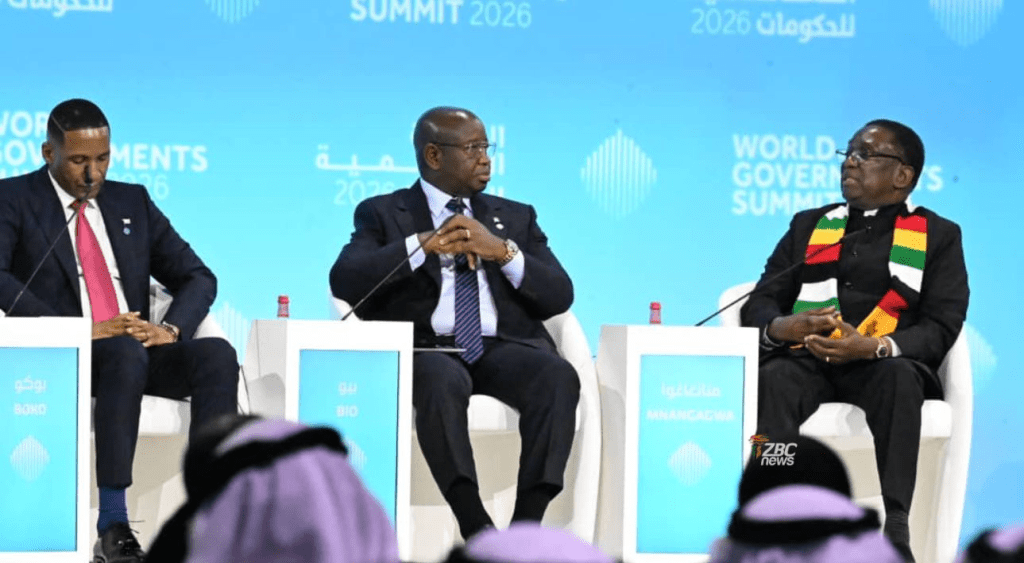
At the recently concluded World Government Summit in Dubai, Tucker Carlson’s interviews with African heads of state revealed more than just political discourse. Beneath the surface of his historical questions lay a subtle voice of racism — an air of superiority and condescension that seemed designed to embarrass rather than enlighten.
Carlson’s framing carried undertones that positioned African leaders as reactive participants in global affairs, rather than equal partners. His questions touched on sensitive issues — from Zimbabwe’s land reform to Western sanctions, and even a provocative reference to recent events in Venezuela in what appeared to be an attempt to corner President Mnangagwa into criticizing global powers.
Mnangagwa’s Strategic Restraint
Mnangagwa refused to be drawn into the trap. When Carlson pressed him on Venezuela and on the emerging tensions between America and its allies versus the rest of the world, Mnangagwa declined to engage in Cold War-style binaries. His decision was not avoidance, but a demonstration of strategic intelligence. Mnangagwa refused to be baited into validating a narrative of victimhood. Instead, he emphasized sovereignty, independence, and the pursuit of development on Zimbabwe’s own terms.
· He emphasized Zimbabwe’s mission in Dubai: to showcase the nation as a serious market for Saudi Arabian businesses, not just for China.
· He redirected the conversation from geopolitical rivalry to economic opportunity, underscoring Zimbabwe’s sovereignty and pragmatic diplomacy.
· On the land issue, Mnangagwa acknowledged Zimbabwe’s historical struggles but reframed them as part of a broader journey toward economic sovereignty, refusing to let the narrative be defined by Western criticism.
· By refusing to play into divisive narratives, Mnangagwa highlighted a broader African determination to define its own role in global affairs.
Conclusion
The Dubai summit was meant to showcase global cooperation, but it also revealed the persistence of subtle biases. In the face of this, African leaders demonstrated that dignity and intellect are the most powerful tools of resistance. Mnangagwa’s refusal to be drawn into divisive narratives — whether on Venezuela, Zimbabwe’s land issue, or Cold War-style rivalries — was more than a diplomatic move; it was a statement of sovereignty, resilience, and vision.
What was meant to embarrass instead became a platform to showcase African agency and intelligence. The subtle voice of racism was met not with defensiveness, but with composure — turning condescension into strength.


 Zimbabwe Rising
Leave a comment