
In 2025, Zimbabwe’s gold mining sector delivered one of its most outstanding performances in history, surpassing national output targets, significantly boosting foreign exchange earnings and showcasing the impact of policy reforms championed under President Emmerson Mnangagwa’s leadership. Anchored by effective strategies aimed at formalising small-scale mining and incentivising deliveries to official buyers, the sector emerged as a critical engine for economic growth in a year marked by strong global prices and resolute implementation of national development blueprints.
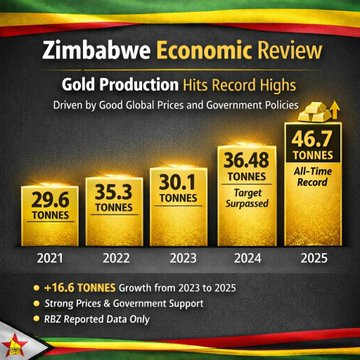
According to data from Fidelity Gold Refinery (FGR), Zimbabwe’s gold production exceeded 40 tonnes in 2025, achieving the annual target ahead of schedule and signalling robust expansion of the sector’s productive capacity. By December, gold output stood at around 46.7 tonnes, representing over 30 percent increase compared to the previous year’s figures. This surge translated into foreign currency receipts topping US $3.7 billion for the first ten months of the year — an 88.9 percent jump year-on-year and a testament to gold’s position as the nation’s largest export earner.
Financial analysts tracking the sector estimate total export earnings for 2025 could approach or exceed US $4 billion, propelled by sustained global gold prices and increased market deliveries.
A striking feature of Zimbabwe’s 2025 gold boom has been the dominant contribution of artisanal and small-scale miners (ASM). These independent producers accounted for roughly 74–75 percent of national output, producing more than 30 tonnes of gold — an increase from just over 20 tonnes in 2024.
This expansion reflects not only the sheer scale of grassroots participation — with estimates indicating hundreds of thousands of ASM operators across the country — but also the government’s initiatives to formalise and support this subsector. Although many small-scale operators remain unregistered (as high as 85 percent according to parliamentary reports), the overall contribution of artisanal miners has become indispensable to the mining sector’s growth trajectory.
The remarkable achievements of 2025 ultimately trace back to policy reforms and strategic interventions central to President Mnangagwa’s administration. Over the past several years, the government has:
- Promoted formalisation and regulation of ASM operations to channel deliveries through official channels like FGR, ensuring enhanced foreign currency inflows.
- Introduced incentive schemes — including prompt payment mechanisms and support funds — that have motivated miners to increase deliveries and formal participation.
- Invested in infrastructure and value-addition facilities, such as milling hubs that connect artisanal operations to safer, more efficient processing technologies and broaden participation in the gold value chain.
These actions align with broader economic reforms aimed at stabilising the macro-economy, attracting investment, and raising productivity in key sectors — priorities frequently underscored by the President and his economic team. The result is an expanding, legally anchored gold sector poised to contribute even more robustly to national coffers.
Zimbabwe’s National Development Strategy 2 (NDS2: 2025–2030) outlines ambitious targets for economic growth, diversification, and inclusive development. Mining, and specifically gold, is recognised as a cornerstone of this strategy — critical for foreign exchange earnings, job creation and industrial linkages. The sector’s stellar performance in 2025 speaks directly to NDS2 priorities, particularly in increasing productivity, formalising the informal sector and promoting community-linked economic activity.
Looking beyond 2025, the sector’s trajectory dovetails with the longer-term goals of Vision 2030, which envisages a prosperous upper middle-income economy by harnessing natural resources responsibly, fostering value addition, and integrating rural actors into the formal economy. Initiatives such as public-private partnerships in gold processing, support for ASM formalisation, and strong export performance are clear steps toward fulfilling Vision 2030’s aims of economic transformation and sustainable growth.
Nevertheless, Zimbabwe’s gold sector in 2025 stands as a demonstration of what coordinated policy, strategic support, and grassroots economic participation can achieve. Under President Mnangagwa’s stewardship, gold mining has not only delivered record figures but also underscored the centrality of mining to national building — from economic resilience today to the ambitious horizons of NDS2 and Vision 2030


 Zimbabwe Rising
Leave a comment