
Recently, we have seen a rise in clickbait journalism disguised as investigative reporting. The latest example is the renewed focus by CITE ZW on renovations done in 2022 at the residence of Senate President Mabel Chinomona. The first question Zimbabweans must ask is simple: why now? Who is driving this sudden interest, and for whose benefit?
This is not a new issue. The Auditor-General’s report has existed for some time. Yet it has been selectively revived and amplified at a politically convenient moment. That alone should raise concern. What is being presented as a fight for accountability looks more like a targeted political assault.
The narrative pushed is one of extravagance and abuse of public funds, with deliberate emphasis on items like curtains and appliances to provoke public anger. But this framing ignores context. It also ignores how state officials’ residences are treated across government. The residence in question serves security and official functions linked to the office held. This is not unusual in Zimbabwe, nor is it unique to one individual.
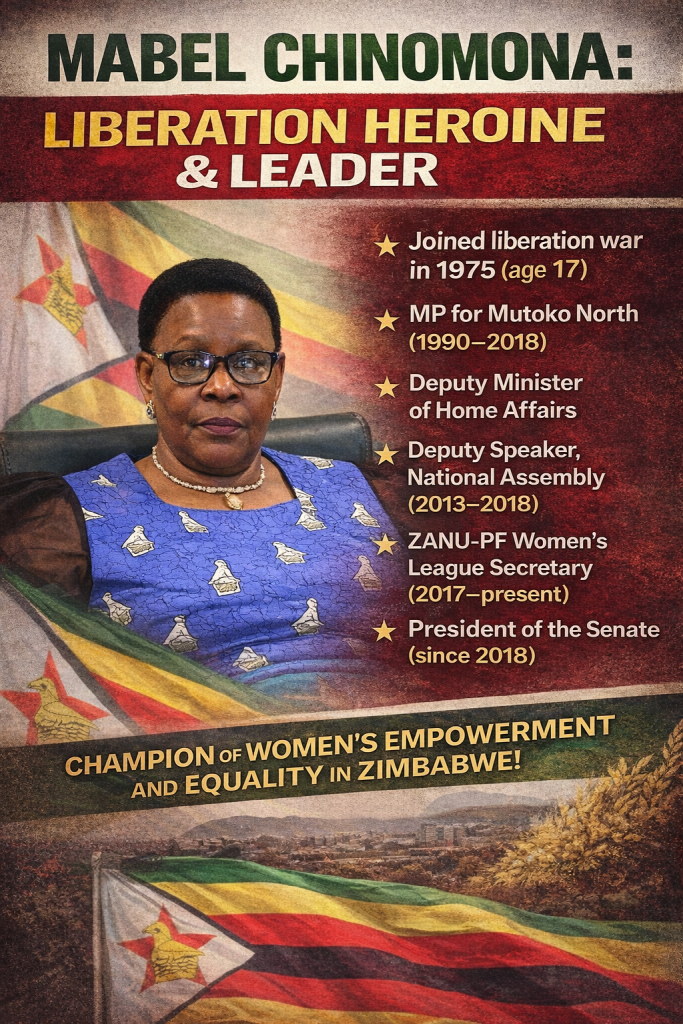
What makes this case different is who is being targeted.
Mabel Chinomona is not a junior figure. She is a liberation war veteran, a senior ZANU-PF leader, Senate President, and a long-standing ally of President Emmerson Mnangagwa. Her political history is well known. She joined the liberation struggle as a teenager and has served the party and the country for decades, from Parliament to the Women’s League, and now at the helm of the Senate. Her recent appointment to a continental parliamentary leadership role confirms her standing beyond Zimbabwe.
Instead of acknowledging this record, her critics have chosen to reduce her entire career to a single audit issue. This is not accidental. It is political.
ZANU-PF is in a sensitive phase. Succession debates are intensifying, and loyalty is being tested. Chinomona has been openly firm in her support for President Mnangagwa. She has publicly rejected calls for him to step aside. That position has put her in direct conflict with competing interests within the party. In such an environment, any perceived weakness becomes a weapon.
This attack must be understood within that reality. It is not about curtains or renovations. It is about removing a perceived obstacle in internal power struggles.
There is also a clear gender dimension that cannot be ignored. Zimbabwean politics remains deeply male-dominated. Male officials routinely benefit from state-funded housing, vehicles, security upgrades, foreign travel, and medical care. These benefits rarely attract sustained outrage or media obsession. Audit issues involving men come and go quietly.
When a woman holds power, the scrutiny changes. It becomes personal, moralistic, and relentless. Chinomona is being judged more harshly not because the issue is bigger, but because she is a woman who has risen and stayed influential. That double standard is real, and Zimbabweans see it.
If accountability is truly the goal, then it must be consistent. The public deserves transparency across the board, not selective outrage. Procurement weaknesses are systemic. If rules were bent, then the system must be fixed, not one woman sacrificed to settle political scores.
Zimbabwe does not benefit from factional warfare disguised as journalism. ZANU-PF does not benefit from tearing down its own liberation veterans to satisfy succession anxieties. And women in politics certainly do not benefit from being punished for surviving and succeeding in hostile spaces.
Let the audit processes proceed fairly and professionally. Let reforms be applied across institutions, not through public character assassination. Mabel Chinomona is not the problem. The problem is a political culture that weaponises accountability when it suits power struggles.
Zimbabwe deserves better than that.


 Zimbabwe Rising
Leave a comment